If you've spent any time in the dating world lately, you've probably heard someone say it.
"He's an avoidant."
"She's anxious."
"My ex was fearful avoidant."
"I only date secure attachment styles now."
Attachment theory has become one of the hottest topics in modern dating. Social media is flooded with videos explaining why your ex disappeared, why your situationship never became a relationship, and why your last three dates didn't call you back.
According to the internet, everyone is either anxious, avoidant, fearful avoidant, or secure. From what I see, the internet thinks there are a whole heck of a lot of avoidants.
In fact, if social media is to be believed, avoidants are everywhere. They're on dating apps. They're at singles events. They're your ex-husband, your ex-wife, your former boyfriend, your former girlfriend, and apparently every person who has ever failed to text back.
The reality is a little more complicated.
Attachment theory has real value. It helps us understand how early experiences can influence the way we connect with others. It can provide insight into our fears, communication patterns, and relationship habits. Used correctly, it can be a powerful tool for self-awareness and personal growth.
Used incorrectly, it becomes a weapon.
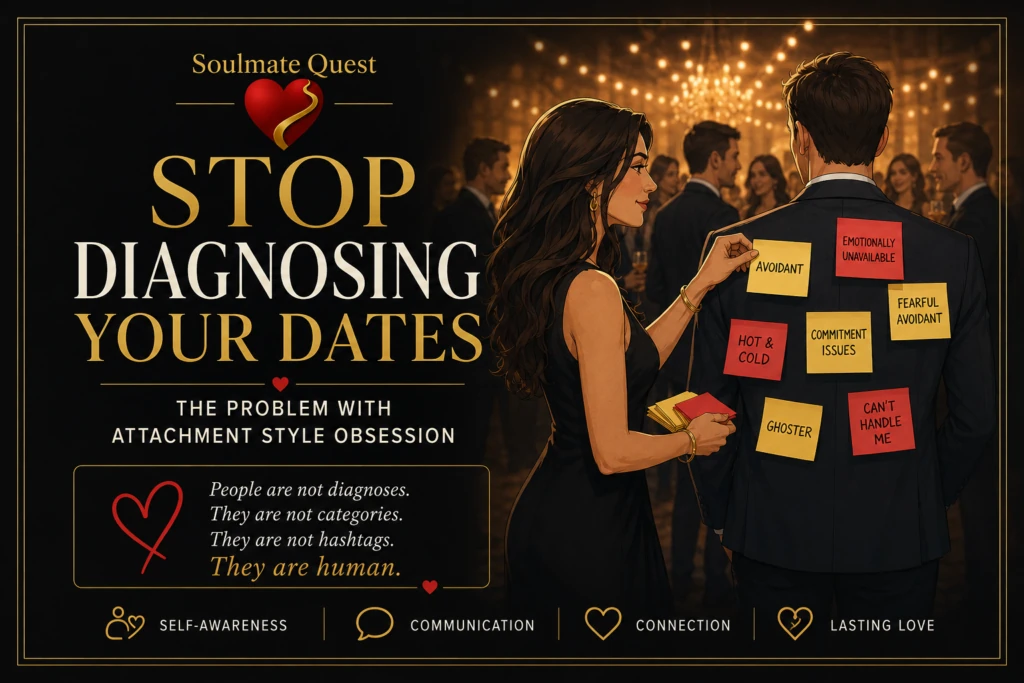
Somewhere along the way, people stopped using attachment styles to understand themselves and started using them to diagnose everyone else.
A man doesn't call after one date? Avoidant.
A woman decides she isn't interested? Avoidant.
Someone needs time to think about a relationship? Avoidant.
Someone ghosts? Avoidant.
Someone doesn't respond to a text message within six hours? Clearly avoidant.
The label has become a catch-all explanation for rejection, disappointment, and heartbreak. And that's where I start to have questions.
Over the last several months, I have had single after single tell me that their ex-wife, ex-husband, former boyfriend, former girlfriend, the person they met online, or the person they met at a singles event was avoidant.
According to the authors of Attached, roughly half of the population is securely attached. Only about a quarter of the population falls into the avoidant category, with a much smaller percentage considered fearful avoidant.
Yet if I based my understanding of attachment theory solely on conversations with singles, I would conclude that nearly everyone in America is avoidant.
That simply can't be true.
If half the population is securely attached, then something else must be going on.
Maybe some of these people truly do have attachment issues. But perhaps we're also witnessing something else: a growing tendency to explain every disappointing dating experience through the lens of attachment theory.
- Rejection hurts.
- Being ghosted hurts.
- Discovering that someone isn't as interested as we hoped…it hurts.
And sometimes it's easier to tell ourselves that someone pulled away because they're avoidant than it is to consider other possibilities.
- Maybe there wasn't enough chemistry.
- Maybe the timing wasn't right.
- Maybe they lacked relationship skills.
- Maybe they were emotionally immature.
- Maybe they were simply the wrong fit.
- Maybe they weren't looking for the same thing as you were.
Not every disappointing dating experience requires a psychological diagnosis.
One of the biggest misconceptions I see as a matchmaker is the belief that attachment style is fixed. People often talk about attachment styles as though they are personality types carved into stone.
They're not.
Most people display different behaviors under different circumstances.
A person who feels secure in one relationship may become anxious in another. Someone who appears avoidant after a painful divorce may become incredibly open and connected with the right partner after healing. Human beings are far more dynamic than social media would have us believe.
What often gets lost in these conversations is that relationships are systems. We do not experience people in a vacuum.
The way one person behaves often influences how the other person responds. If someone feels criticized every time they speak, they may begin withdrawing from conversations. If someone feels judged, controlled, interrogated, or emotionally overwhelmed, they may create distance. If every disagreement turns into a three-hour discussion, they may stop sharing their thoughts altogether. Does that automatically make them avoidant? Or are they simply avoiding pain? People generally move toward pleasure and away from pain. That's not attachment theory. That's human nature.
This is where social media psychology often gets it wrong. Someone watches a few videos, reads a bestselling book, and suddenly starts diagnosing their spouse, ex-partner, or the person they dated for three weeks.
"He won't talk to me. He's avoidant."
Maybe.
Or maybe every conversation feels like a trap.
"She needs constant reassurance. She's anxious."
Maybe.
Or maybe trust has been broken repeatedly.
The truth is that very few people have enough information, training, or objectivity to accurately diagnose another person's attachment style. Yet people are doing it every day based on a handful of text messages, a breakup conversation, or a TikTok video.
The other problem is that attachment theory has become an excuse.
Instead of asking, "What attachment style was my ex?" A better question might be, "What role did I play in this relationship?" That question isn't nearly as comfortable. It's much easier to diagnose someone else than it is to examine ourselves.
Instead of focusing entirely on another person's shortcomings, we might ask: What was it like to be in a relationship with me?
- Did my partner feel emotionally safe?
- Did they feel respected?
- Did they feel heard?
- Did they feel appreciated?
- Did I create an environment that encouraged openness, or one that encouraged withdrawal?
Those questions are far less comfortable than diagnosing someone else, but they are infinitely more useful.
Ironically, the healthiest people I meet rarely spend much time talking about attachment styles. They focus on behavior.
- Does this person communicate consistently?
- Do they keep their word?
- Are they emotionally available?
- Do they show genuine interest?
- Do they make an effort?
- Do I feel respected?
Those questions tell you far more about relationship potential than trying to determine whether someone is a fearful avoidant with anxious tendencies and a side of childhood abandonment issues.
At the end of the day, attachment theory can be useful. It can help us understand ourselves and become better partners. But it should never become an excuse to put people into boxes.
The goal isn't to become an expert at identifying everyone else's attachment style.
The healthiest people aren't obsessed with identifying avoidants. They're focused on becoming the kind of person who creates trust, safety, honesty, and connection. Because when relationships fail, the lesson is rarely found in labeling someone else. It's usually found in understanding ourselves.
At Soulmate Quest, we spend far less time labeling people and far more time understanding them. Healthy relationships aren't built by diagnosing each other. They're built through communication, self-awareness, emotional maturity, accountability, and shared values. The goal isn't to find someone with the perfect attachment style. The goal is to find someone willing to build a healthy relationship with you.