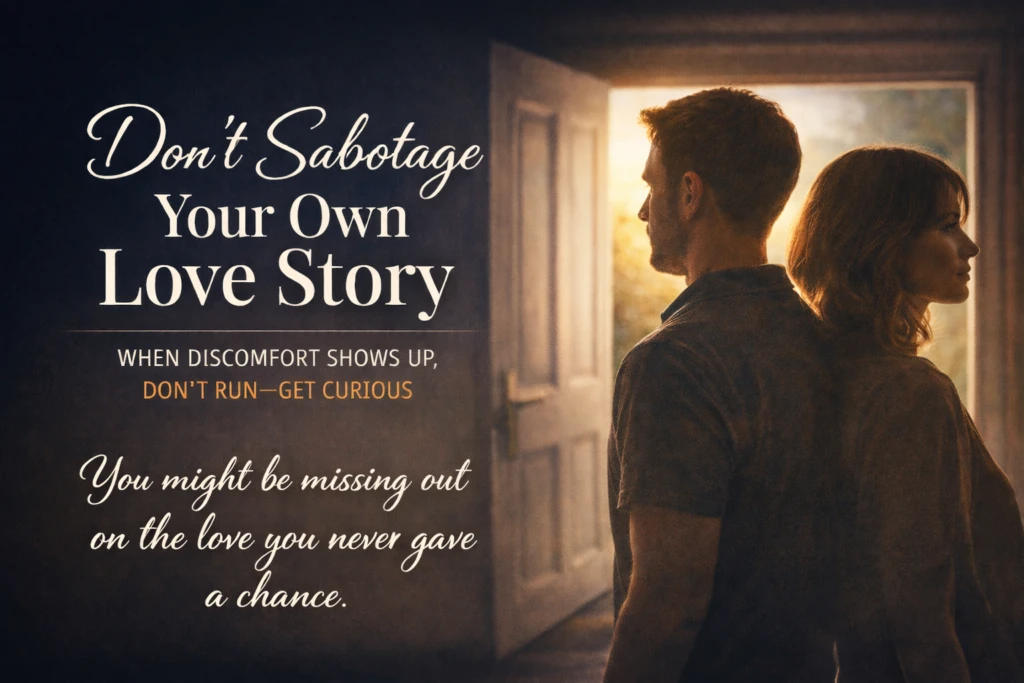
Let’s talk about one of the most common and least talked about dating patterns I see. It’s subtle, it’s sneaky, and it’s responsible for more missed love connections than people realize. I’m talking about self-sabotage. Not the loud kind, not the dramatic cheating, ghosting, toxic chaos kind. No, I’m talking about the quiet exit. The slow emotional fade that starts the minute you feel uncomfortable.
And here’s the important distinction, you’re not leaving because there’s anything glaringly wrong. There’s no betrayal, no giant red flag waving in the wind, no moment where your gut is screaming, “Run.” Instead, it’s something small. He says something you didn’t quite like. She makes a comment that lands sideways. Something feels off. And instead of leaning in with curiosity, you lean out with distance.
This is where the sabotage really begins. You don’t ask what they meant. You don’t clarify intent. You don’t say, “Hey… when you said that, what did you mean?” You fill in the blanks yourself. And let’s be honest, the stories we write in our heads are rarely generous. You assume tone. You assume intention. You assume incompatibility. You build an entire emotional case file based on one sentence that may have been poorly worded, misinterpreted, or completely innocent. But instead of investigating, you quietly start heading toward the door.
Here’s the truth most people don’t realize. Discomfort isn’t always danger. Sometimes discomfort is simply vulnerability knocking. It’s emotional intimacy approaching. It’s the fear of getting hurt waking up. It’s old wounds tapping you on the shoulder saying, “Remember what happened last time?” So what do we do? We retreat. We create distance before attachment can form, because you can’t get hurt by someone you never fully let in. It feels protective. It feels smart. It even feels empowering in the moment. But more often than not, it’s fear wearing a very sophisticated outfit.
I know this pattern not just professionally, but personally. When I met my husband Ken, everything felt so perfect it almost made me uncomfortable. It was easy. Natural. Aligned. There was a calmness between us that I had never experienced before. And instead of relaxing into it, part of me kept waiting for the hitch. It felt too good. Too smooth. Too emotionally safe. Surely something had to be wrong.
To make matters more complicated, I had well-meaning friends pointing out potential chinks in the armor of my white knight. Little observations. Small questions. Subtle doubts planted like seeds. And if I’m being honest, I started reading into things that didn’t need reading into. I began analyzing tone, timing, word choice. There was absolutely a path where I could have blown up a beautiful, healthy relationship simply because it felt unfamiliar in its goodness.
But instead of pulling away, I made a conscious decision to lean in. I got curious instead of defensive. I started asking clarifying questions. I shared when something made me pause instead of silently filing it away as evidence. And those conversations changed everything. What I discovered through communication was not a man full of hidden flaws, but a man full of consistency, integrity, and emotional safety.
Those questions helped me see clearly that I had truly found my person in Ken. And had I chosen distance over dialogue, I could have easily sabotaged one of the greatest relationships of my life by building a fortress around my heart instead of a bridge between ours.
You’ll hear this same pattern in the way people describe why things ended. “I just didn’t feel it.” “Something felt off.” “I can’t explain it… I just lost interest.” And listen, sometimes those instincts are valid. But sometimes they’re defense mechanisms dressed up as intuition. Because real connection requires tolerance for a little emotional friction. Two strangers learning each other’s communication styles will have awkward moments. Misfires happen. Poorly timed jokes happen. Comments land wrong. That’s not incompatibility, that’s humanity.
Here’s the million-dollar question. How many potential relationships have ended not because they were wrong, but because they were early? How many people did you walk away from simply because you felt uncomfortable for a moment and didn’t stay long enough to understand why? You’ll never know how that story might have unfolded, because you ended the book in Chapter Two.
I see this all the time in matchmaking. Clients come back describing someone as great on paper, kind, attractive, successful, easy to talk to. But then comes the “however.” There was just one comment. One moment. One misinterpretation. One unclarified assumption. And just like that, the opportunity is gone, not because the connection lacked potential, but because curiosity never had a chance to speak before conclusion took over.
Healthy dating requires curiosity. Self-sabotage thrives on conclusion. Curiosity says, “Help me understand what you meant.” Conclusion says, “I’ve seen enough.” Curiosity builds bridges. Conclusion builds toward exits. And the people who find lasting love aren’t the ones who never feel uncomfortable, they’re the ones who don’t run the minute they do.
If you recognize yourself in this pattern, here’s the growth edge. Stay five minutes longer emotionally. Ask one more question. Clarify one assumption before writing the ending. You’re not lowering your standards; you’re increasing your understanding. Because the goal isn’t to ignore red flags, it’s to stop manufacturing them out of momentary discomfort.
So, the next time you feel that familiar urge to emotionally head for the door, pause. Ask yourself, is this intuition or is this fear? Because one path protects you from hurt, but the other opens the door to love. And if you’ve been wondering why great matches never seem to stick, it might not be who you’re meeting, it might be how quickly you’re leaving.
Before I close, I want to speak directly to the part of you that might be recognizing yourself in this pattern. Because awareness is powerful, but guidance is transformational. The truth is, self-sabotage is incredibly difficult to see when you’re the one inside it. We all have blind spots in dating. Emotional blindsides that come from past heartbreak, betrayal, divorce, or simply patterns we developed to protect ourselves. Those protective instincts once served a purpose. They kept you safe. But sometimes they also keep love out.
As a matchmaker and dating coach, part of the work I do goes far beyond introductions. Yes, I connect incredible people. Yes, I curate compatible matches. But I also help my clients recognize the emotional tripwires that get pulled once they start dating someone wonderful. Because what often happens isn’t that the match is wrong. It’s that the fear response gets activated. The discomfort rises. The over-analysis begins. And before the connection has time to deepen, the exit door quietly opens.
Sometimes we all need someone outside the relationship dynamic to help us slow down, ask better questions, and separate intuition from fear. Someone who can gently say, “This might be a blindside you can’t see from where you’re standing.” That’s where coaching becomes invaluable. I help clients stay present when they would normally retreat. I help them communicate when they would normally assume. I help them build emotional endurance so they don’t walk away from healthy love simply because it feels unfamiliar. Because the goal isn’t just finding your person. It’s being emotionally ready to receive them when they arrive.
So if you see yourself in this pattern, if you’ve walked away from good people too quickly, or if you feel that reflex to pull back the minute vulnerability shows up, know that you don’t have to navigate that alone. Sometimes the greatest breakthroughs in love happen not when you meet someone new, but when you finally see yourself clearly. And that clarity can change everything.
Jeannine Kaiser Wolfe
/coaching/
#DatingSelfSabotage #RelationshipPatterns #DatingMindset #EmotionalAvailability #FearOfIntimacy #DatingAwareness #LoveBlocks #RelationshipGrowth #AttachmentStyles